

How to calm a racing mind before bed is one of the most common sleep struggles. You turn off the light, and your brain immediately pulls up every awkward conversation and unfinished task from the day. If that sounds familiar, you’re in good company — and the cause is usually your evening habits rather than any flaw in you.
A good wind-down routine is the solution. Sleep isn’t an on/off switch. It’s a physiological transition, and you can guide it with a short, repeatable 30-minute routine.
Quick Answer
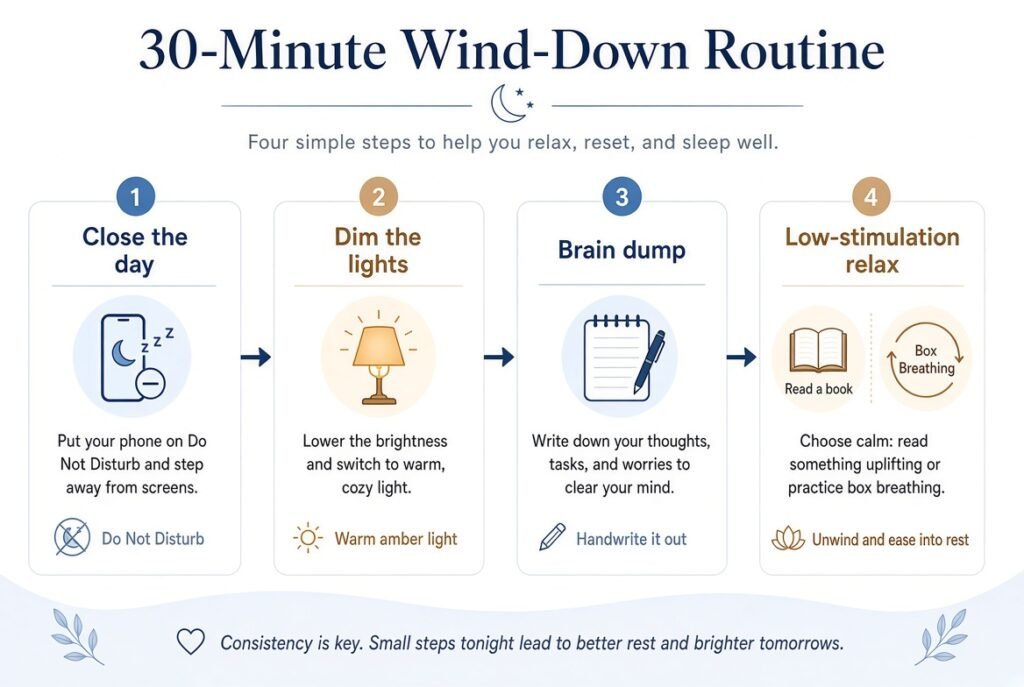
A 30-minute wind-down routine works in four simple steps:
- Close the day
- Dim your lights
- Unload your thoughts onto paper
- Finish with low-stimulation relaxation
No supplements required.
Why Your Brain Refuses to Shift Into Sleep Mode
In the evening, your body should raise melatonin and lower core body temperature. Bright overhead lighting and unresolved mental to-dos work against both, keeping your sympathetic (fight-or-flight) system active.
When arousal stays high, sleep latency (the time it takes to fall asleep) gets longer. A buffer zone between your busy day and bed gives your nervous system time to step down.
The 30-Minute Step-by-Step Wind-Down Protocol
Minutes 30–20: Close and Dim (Light Regulation)
- Close work tabs and set your phone to Do Not Disturb. Put it out of arm’s reach, ideally charging outside the bedroom.
- Turn off overhead lights and switch to warm, amber lamps or low red-spectrum lighting.
Why it works: Specialized light-sensing cells in your retina are most sensitive to blue-rich light. Warm, dim light sends a weaker “daytime” signal to your body clock.
Minutes 20–10: The Brain Dump (Clear the Loop)
Racing thoughts at night are often your brain trying not to forget tomorrow. Take a physical notepad and:
- Write everything left undone.
- Write your top three priorities for tomorrow.
- Close the notebook.
Evidence: A 2018 Baylor University study found that people who spent five minutes writing a to-do list before bed fell asleep faster than those who wrote about completed tasks.
Minutes 10–0: Physical and Sensory Decompression
Keep the last ten minutes analog:
- Read a physical book under a low-wattage light.
- Do light, passive stretching.
- Try box breathing: inhale 4 seconds, hold 4, exhale 4, hold 4. Repeat for 2–4 minutes.
Pick one or two of these — the goal is calm, not another to-do list.
Optimize the Bedroom So the Routine Sticks
- Keep it cool (roughly 60–67°F / 15–19°C).
- Try a warm bath or shower 1–2 hours before bed.
- Keep it dark and quiet (blackout curtains or eye mask + white/brown noise if needed).
- Keep the bed for sleep only — avoid working or scrolling in bed.
Daytime Habits That Make Nighttime Easier
- Caffeine: Effects can linger for hours. Aim for a mid-afternoon cutoff.
- Alcohol: May make you drowsy but fragments sleep later.
- Morning light + consistent wake time: These anchor your body clock more than any bedtime trick.
- Exercise: Helpful overall, but intense workouts right before bed can backfire for some people.
Optional Gear to Support Your Routine
You don’t need any of this. A lamp, notepad, and book work fine. If you want tools that make the habit easier:
- Hatch Restore 3 (best all-in-one) – sunrise alarm, sound machine, and reading light in one.
- JALL Wake Up Light (best budget pick) – gradual fade with physical buttons.
- Non-ticking analog alarm clock – keeps the phone out of the bedroom.
- Simple notepad + pen for the brain dump.
Quick Comparison: Sleep Aids vs Behavioral Habits
| Approach | Best for | Key consideration |
|---|---|---|
| Medications & supplements | Short-term, under medical guidance | Discuss with a doctor |
| Sunrise clocks & sound machines | Supporting consistent environment | Supportive tools, not a cure |
| The 30-minute wind-down | Racing thoughts & long sleep latency | Free, low-risk, builds over time |
| CBT-I | Chronic insomnia | Recommended first-line treatment |
Frequently Asked Questions
What if my mind still races during the brain dump?
Try “scheduled worry time.” Write the problem + one small action for tomorrow, then close the notebook.
Do I really need to remove my phone from the bedroom?
Not mandatory, but it helps most people. Even with night mode, the temptation stays high.
How long until I notice a difference?
Many people feel calmer within a few nights. Give it 2–3 weeks of consistency.
What if I wake up at 3 a.m. with racing thoughts?
Keep lights low, write the thought down. If still awake after ~20 minutes, get up and do something quiet in dim light.
Is it normal to take 20–30 minutes to fall asleep?
A short delay is normal. Consistently longer is worth discussing with a professional.
When to See a Doctor
If trouble sleeping happens at least three nights a week for three months or more, or it affects your mood, safety, or daytime functioning, talk to a healthcare professional. Loud snoring, gasping, or severe daytime sleepiness can signal conditions (like sleep apnea) that a routine alone won’t fix.
About this guide
This routine draws on established sleep-hygiene research and my own experience swapping late-night scrolling for an analog wind-down, which noticeably shortened how long it took me to fall asleep. This is general information, not medical advice.
Disclosure: This post contains Amazon affiliate links. If you buy through them, I may earn a commission at no extra cost to you. I only include products that fit the routine.