
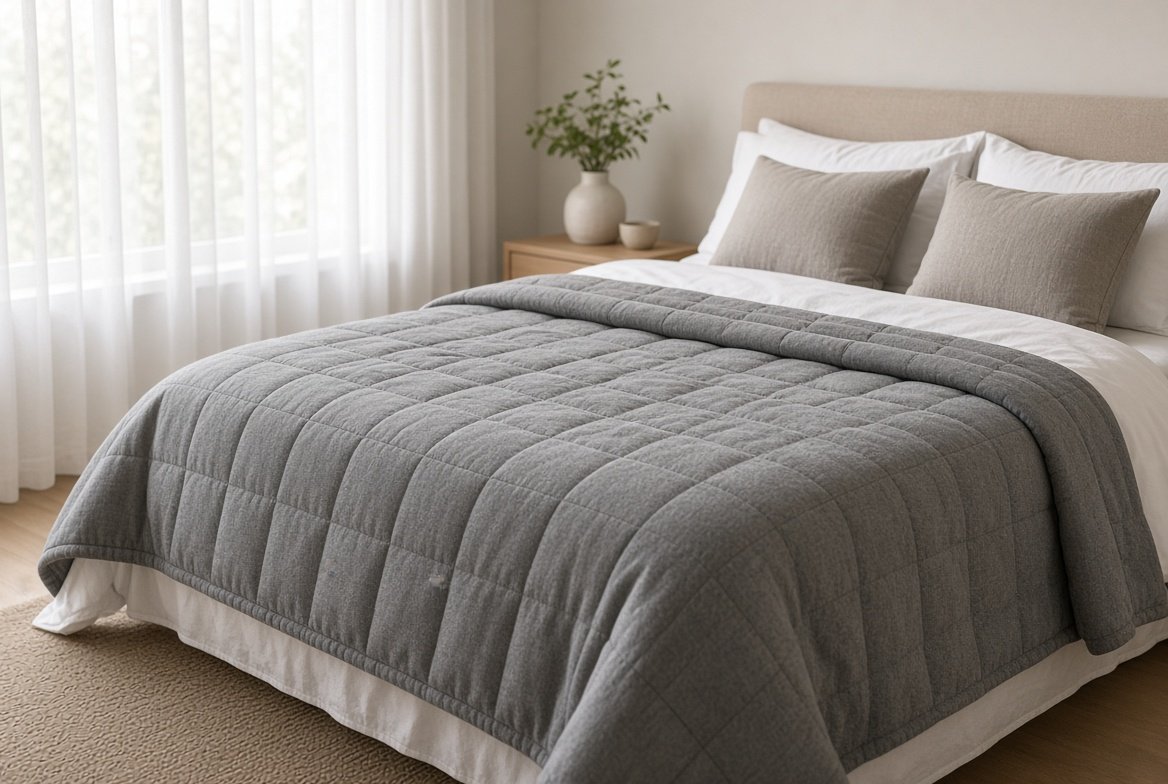
A weighted blanket is a heavy, evenly filled blanket, usually somewhere between 5 and 30 pounds, designed to rest gentle pressure across your body while you sleep. If you’re reading this, you probably want to know one thing: will it actually help you sleep better, or is it just an expensive duvet that makes the bed feel like a sandbag?
Fair question. In the last few years weighted blankets have gone from a niche sensory tool to a fixture on bedroom wish lists, and the claims have grown right along with their popularity. Some of those claims are well supported. Some are stretched. And a few mistakes, like picking the wrong weight or buying one for a toddler, can go wrong in ways the product pages rarely mention.
This is the guide we’d want to read before buying one. It covers what a weighted blanket is, how it works, what the research really shows (and what it doesn’t), who should skip it, how to choose the right weight, fabric and filling, and how to keep it clean. No hype, just what you need to decide.
The short version
- Most adults feel best under a blanket that weighs about 10% of their body weight, give or take a couple of pounds.
- The evidence is encouraging for insomnia and anxiety-related restlessness in adults, but the studies are small.
- Weighted blankets are not safe for infants or toddlers, or for anyone who can’t lift the blanket off on their own.
- If you sleep hot, the fabric and filling matter as much as the weight.
What is a weighted blanket?
A weighted blanket is a blanket with extra fill stitched into small pockets, so it weighs far more than a normal duvet. Most run between 5 and 30 pounds, and some go heavier. The fill is usually glass microbeads or plastic pellets, layered with batting so the blanket stays warm and doesn’t rattle when you roll over (Sleep Foundation).
Think of it as the opposite of a fluffy comforter. A down duvet traps air and weighs almost nothing. A weighted blanket is built around gravity: the pockets keep the fill spread evenly, so the weight settles across your shoulders, torso and legs instead of pooling in one spot.
You’ll also see them sold as gravity blankets or heavy blankets. Same idea, different label. Some are a single piece. Others have a removable cover you can wash while the weighted insert stays put, a detail that matters more than it sounds.
This guide focuses on full-size bed blankets. Lap pads and kids’ versions follow the same principles, with extra caution for children.
How do weighted blankets work?
Weighted blankets are thought to work through deep pressure stimulation, the calming effect of firm, even pressure on the body. A tight hug does it. So does swaddling a baby, or the way a heavy quilt feels on a cold night. Cleveland Clinic notes that occupational therapists have long used deep pressure touch to help calm children with autism, and weighted blankets borrow the same idea for bedtime.
The proposed chain of events goes like this. Pressure signals reach the nervous system and nudge it away from its alert, fight-or-flight mode toward its rest-and-digest mode. Heart rate may slow and muscles may loosen. Sleep Foundation adds that weighted blankets are believed to raise feel-good chemicals like serotonin and dopamine and lower the stress hormone cortisol, though it flags that these claims are still being researched.
There’s also a simpler, mechanical theory. Extra weight makes every toss and turn take more effort, so restless sleepers may fidget less, and fewer small awakenings could mean more continuous sleep.
Now the honest caveat. The hormone story is the part most often oversold. The much-shared melatonin and oxytocin findings come from single-night lab studies of roughly two dozen healthy adults, and nobody has shown they translate into better sleep over time (Acibadem). The mechanism is plausible and partly measured, but not fully mapped. Treat any blanket that promises to “reset your nervous system” with healthy suspicion.
Weighted blanket benefits: what the research actually shows
There’s encouraging evidence for insomnia and anxious restlessness in adults, but it comes from small studies, and the bigger claims run ahead of the data. As a sleep psychologist told Cleveland Clinic, the current studies are small and have some limitations.
Insomnia. The strongest result is a Swedish randomized trial published in the Journal of Clinical Sleep Medicine in 2020. It followed 120 adults with insomnia and a psychiatric diagnosis, such as depression, bipolar disorder, generalized anxiety disorder or ADHD, for four weeks. Half slept under a roughly 8 kg (about 17.6 lb) chain blanket, half under a light control blanket. About four in ten people in the weighted group at least halved their insomnia severity, compared with roughly one in twenty-eight in the control group (Acibadem). A separate study of 102 adults with insomnia also reported better sleep quality. One catch: everyone knew which blanket they had, so expectation probably played a part.
Anxiety. Small, short studies have linked weighted blankets with lower anxiety, including during dental procedures and cancer infusions. Results lean positive, but exposure often lasts minutes, not nights.
Children with autism. Here marketing runs furthest ahead. A randomized crossover trial of 67 children with autism found no objective improvement in sleep, although kids and parents preferred the blanket. The American Academy of Neurology’s 2020 guidance found no evidence that routine weighted blanket use improves sleep in these children, while noting it hasn’t been reported as dangerous.
| What people claim | What studies found | How much to trust it |
|---|---|---|
| Better sleep for adults with insomnia plus anxiety or depression | One 4-week randomized trial, 120 adults, positive result | Moderate: promising, but a single trial |
| Less anxiety | Several small, short studies, mostly positive | Low to moderate |
| Better sleep for children with autism | One randomized trial, 67 children, no objective gain | Moderate that it doesn’t add sleep; the comfort was real |
| A melatonin or oxytocin boost | Single-night lab studies, about two dozen healthy adults | Very low |
The bottom line: a weighted blanket is a low-risk comfort tool that may help some adults wind down. It isn’t a cure, and good sleep habits (or CBT-I, the first-line therapy for chronic insomnia) still come first.
Who should use a weighted blanket (and who shouldn’t)
A weighted blanket tends to suit adults who feel wired at bedtime, fidget through the night, or simply love the feeling of being tucked in tight. If you’re a healthy adult who can easily lift it off, the downside is usually limited to feeling too warm or a little pinned.
It’s not for everyone, though, and a few groups need real caution.
Never for infants and toddlers. A small child may be unable to lift the weight off their face or chest. Sleep Foundation says weighted blankets are generally considered safe only for children aged 3 and older who weigh at least 50 pounds, and recommends checking with a family doctor first.
Anyone who can’t remove it unaided. That includes frail older adults and people with limited arm strength.
Talk to your doctor first if you have:
- Sleep apnea or another breathing condition such as asthma
- Low blood pressure
- Type 2 diabetes
- Poor circulation or reduced sensation, since pressure on numb skin can go unnoticed
- Claustrophobia or a history of trauma involving restraint, which can make the pressure feel threatening instead of soothing
If you’re pregnant, recovering from surgery, or simply unsure, ask your healthcare provider before buying.
Stop using the blanket if you wake up short of breath, notice new numbness, or find it makes your anxiety worse. This guide doesn’t replace advice from your clinician.
How heavy should a weighted blanket be?
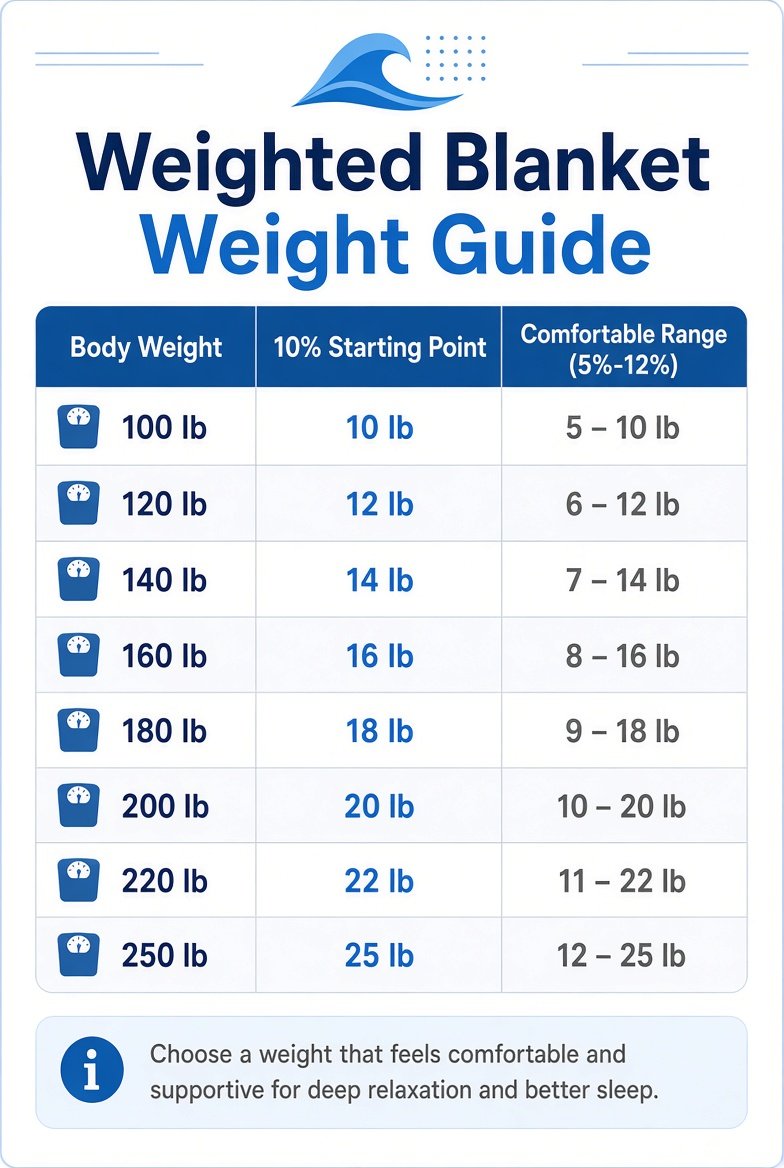
Most adults should start with a blanket that weighs about 10% of their body weight, so 15 pounds for a 150-pound adult and 20 pounds for a 200-pound adult. Sleep Foundation says preferences range from about 5% to 12%, and Cleveland Clinic suggests going no heavier than 10%.
Worth knowing: the 10% rule is expert convention, not a tested threshold. In the Swedish trial, about one in ten people found the heavier blanket uncomfortable and stepped down to a lighter one (Acibadem). Treat the number as a starting point, not a prescription.
| Your body weight | 10% starting point | Comfortable range (5% to 12%) |
|---|---|---|
| 100 lb (45 kg) | 10 lb | 5 to 12 lb |
| 120 lb (54 kg) | 12 lb | 6 to 14 lb |
| 140 lb (64 kg) | 14 lb | 7 to 17 lb |
| 160 lb (73 kg) | 16 lb | 8 to 19 lb |
| 180 lb (82 kg) | 18 lb | 9 to 22 lb |
| 200 lb (91 kg) | 20 lb | 10 to 24 lb |
| 220 lb (100 kg) | 22 lb | 11 to 26 lb |
| 250 lb (113 kg) | 25 lb | 13 to 30 lb |
Between sizes? Go lighter if you run hot or dislike feeling restricted, and heavier if you love a firm hug.
A better test than any chart is functional. The blanket should be heavy enough that you notice it, light enough that you can throw it off in one motion without sitting up, and cool enough that you don’t wake up sweating. If it fails any of those, the weight is wrong.
Kids and couples. Don’t just plug a child’s weight into the 10% rule. Sleep Foundation recommends asking a family doctor and leaning toward the lower end, and notes that blankets made for kids typically weigh 3 to 12 pounds. Couples usually do better with two individual blankets than one shared king.
Choosing a weighted blanket: filling, fabric and size
Filling, cover fabric and size change how a blanket feels and sleeps more than most people expect.
| Filling | How it feels | Trade-offs |
|---|---|---|
| Glass microbeads | Fine, sand-like drape; slimmer for the same weight | Often costs more; check that seams are tightly stitched |
| Plastic pellets | Bulkier, a little lumpier and noisier | Usually cheaper |
| Chain fill | Weight in long lines, as in the Swedish trial | Uncommon in stores; mostly seen in clinical settings |
No study has compared fill types for sleep outcomes, so choose by feel and by how well the blanket handles heat (Acibadem).
Quilting. Look for small, sewn-through pockets. They keep the fill from sliding to the edges.
Cover. A removable duvet-style cover makes washing easy and lets you swap fabrics with the seasons. Without one, you’re stuck spot-cleaning a 15-pound object.
Size. Choose by sleeper, not by mattress. A blanket that lies over you and stops near the edge of the bed keeps its weight where you need it, while one that hangs off the sides tends to drag toward the floor.
Finally, check the return policy, since you may need to try more than one weight.
Weighted blankets for hot sleepers
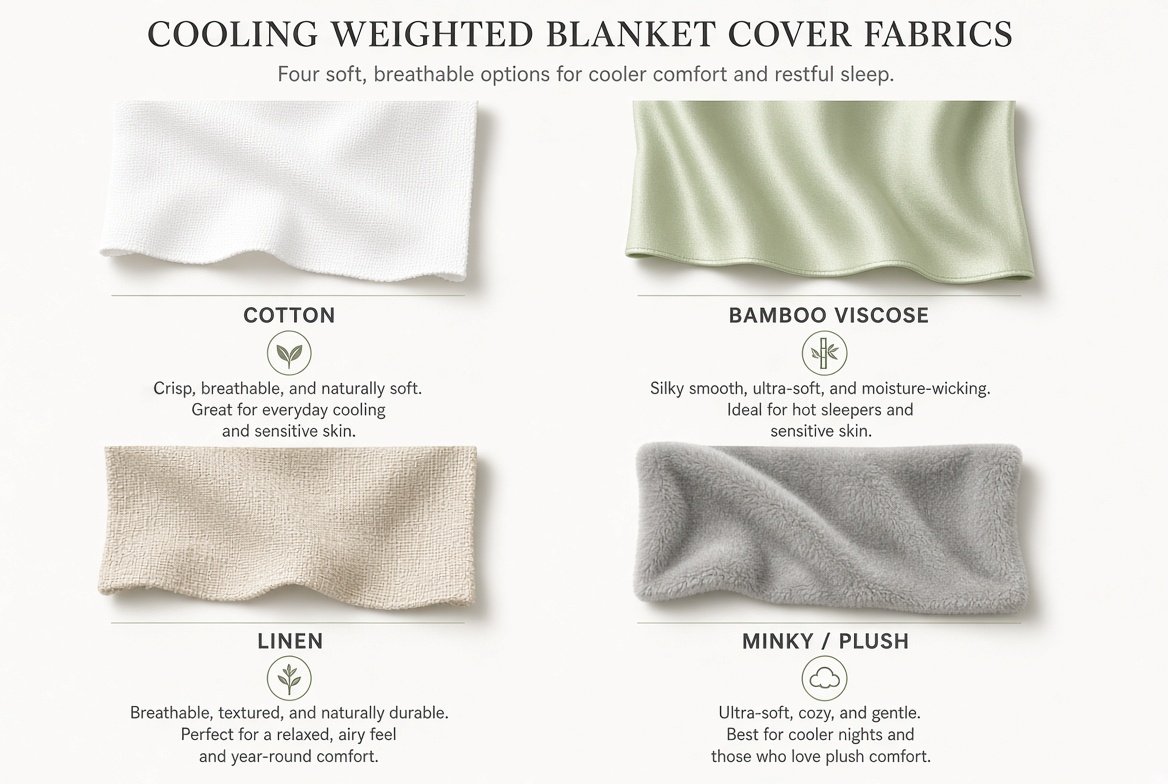
Weighted blankets can sleep warm, but you can plan around it. Dense fill and thick covers trap heat, and overheating breaks up sleep. Sleep Foundation notes that the material and fill both affect how hot a blanket sleeps (source). Here’s how to stay comfortable:
- Pick a breathable cover. Cotton, bamboo-derived viscose or lyocell run cooler than fleece or plush.
- Stay at the light end of your range. Less weight means less heat and less pressing.
- Choose small, evenly sewn pockets. Even weight avoids hot, heavy patches.
- Cool the room. Roughly 60 to 67 degrees Fahrenheit (15.5 to 19.5 degrees Celsius) is a common target for sleep (Acibadem).
- Swap covers by season. In a heatwave, a night off is fine.
| Cover fabric | How it feels | Best for |
|---|---|---|
| Cotton | Crisp and breathable | Year-round; easy to wash |
| Bamboo viscose or lyocell | Silky, drapey, tends to feel cool | Hot sleepers |
| Linen | Airy and textured | Summer and warm climates |
| Minky or plush microfiber | Soft, warm, cozy | Cold bedrooms; often too warm for hot sleepers |
If you wake damp or kick the blanket off every night, the weight isn’t helping you. Try a different cover or weight first. For fabric comparisons, weight ranges and bedroom tips, read our full guide to weighted blankets for hot sleepers.
How to use and wash a weighted blanket
Give it a fair trial before you decide. Some people find the weight strange for the first few nights and settle into it by the end of the first week. Lay it over your body from the shoulders down, keep it off your face and neck, and make sure you can slide it off with one hand.
To find out whether it’s really helping, keep a simple sleep diary for two weeks without the blanket and two weeks with it. Jot down roughly how long it took to fall asleep, how often you woke, and how rested you felt from one to five.
Washing it
- Check the care label first, because instructions vary a lot between brands.
- Remove the cover and wash it like any other bedding.
- For the insert, remember that heavy blankets can strain a home machine. Anything much above 15 pounds may need a large-capacity washer or spot cleaning.
- Air-dry flat to protect the stitching that holds the fill in place.
- Inspect the seams from time to time. Leaking beads are a choking hazard around small children and pets, and a good reason to retire the blanket (Acibadem).
Common mistakes and a buying checklist
Most disappointment with weighted blankets comes from a handful of avoidable mistakes:
- Assuming heavier is better. No trial has shown that more weight means more benefit.
- Ignoring the cover and fill. A great weight in a hot fabric still ends with you awake at 2 a.m.
- Sizing for the mattress. Size for the sleeper, or the weight ends up on the floor.
- Buying for a child by the adult rule. Ask a doctor first.
- Expecting a cure. It’s a comfort tool that works best alongside solid sleep habits, not instead of them.
Before you buy, run through this checklist:
- I’ve checked with my doctor if I have a breathing, circulation, blood pressure or diabetes concern
- I know my target weight (about 10% of body weight, give or take)
- The cover is breathable and removable
- The size fits me, not the whole mattress
- I can lift it off myself in one motion
- The seller offers a real trial period or easy returns
Weighted blanket FAQ
Do weighted blankets actually work?
For some adults, modestly. One four-week randomized trial found large improvements in insomnia severity among adults with insomnia and a psychiatric condition. Evidence for healthy sleepers is thin, and results in children with autism showed comfort but no objective sleep gain.
Is it safe to sleep with a weighted blanket every night?
For healthy adults who can remove it easily, current evidence raises no safety concern, though long-term controlled data is lacking. People with sleep apnea, breathing problems, low blood pressure or diabetes should check with a doctor first.
How heavy should a weighted blanket be?
About 10% of your body weight is the usual starting point, with a comfortable range of roughly 5% to 12%. Go lighter if it feels restrictive or hot.
Can a weighted blanket be too heavy?
Yes. If it limits your movement, makes breathing feel harder, or you can’t push it off in one motion, it’s too heavy. Move down a size rather than getting used to it.
Are weighted blankets good for anxiety?
They may help some adults feel calmer, especially at bedtime. Small studies are positive but short, and a blanket hasn’t been shown to treat an anxiety disorder, so it shouldn’t replace therapy or prescribed medication.
Do weighted blankets make you hot?
They can. Dense fill and thick covers trap warmth. Choose a breathable cover such as cotton, bamboo viscose or lyocell, stay at the light end of your range, and keep your bedroom cool.
Is a weighted blanket right for you?
A weighted blanket won’t fix a sleep problem on its own, but for many healthy adults it’s a low-risk way to make bedtime feel calmer. Start with about 10% of your body weight, pick a breathable removable cover, size it to you rather than the bed, and give it a couple of weeks with a simple diary. If it doesn’t help, you can return it.
If you’re dealing with long-running insomnia, loud snoring, or anxiety that’s wrecking your nights, talk to a clinician. A blanket works best as a supporting player.
Ready to keep going? Explore more sleep guides on SleepWelSpace, or browse our picks to find a blanket that suits your weight, your bed and your temperature.