
By LeoTheGreat, founder of SleepWellSpace.com · Last updated October 16, 2026
The standard answer is a blanket that weighs about 10% of your body weight, then a pound or two either way for comfort. That rule is a good starting point, not a law, and this guide shows you how to adjust it for your body, your sleep and your household. For product recommendations and a full buying guide, see our Best Weighted Blankets for Sleep (2026) roundup.
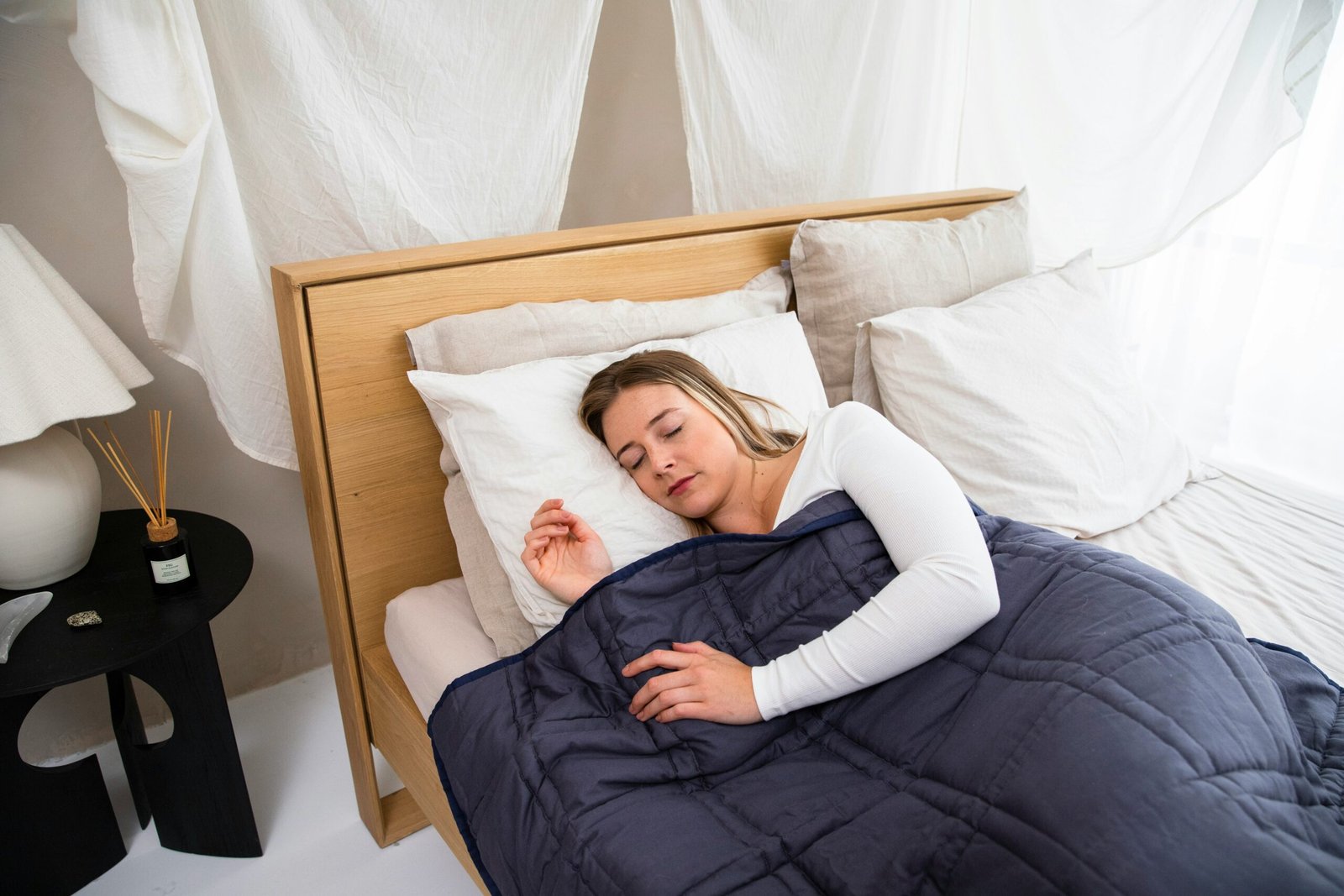
The 10% rule, in plain numbers
Take your body weight and move the decimal point. A 150 lb (68 kg) adult starts at 15 lb (6.8 kg). A 200 lb (91 kg) adult starts at 20 lb (9.1 kg). That’s the guideline you’ll see from sites like the Sleep Foundation, and it’s the one most brands print on their size charts.
The catch is that blankets don’t come in every weight. Most brands sell in steps of two or three pounds, and 10, 12, 15, 17 and 20 lb are common sizes. So you almost always have to round, and which way you round matters more than the arithmetic.
- Round down if you run hot, sleep on your side, are brand new to weighted blankets, or tend to feel boxed in under heavy covers.
- Round up if you love firm pressure, sleep on your back, or know from experience that light blankets don’t register with you.
- Don’t chase a heavier blanket for more benefit. One sleep specialist at Baylor College of Medicine suggests treating 10% as an initial weight and says anything over 25 lb is likely too heavy for most people.
If you remember one thing from this guide, make it this: the 10% figure is where you start, and your own comfort decides where you finish.
Weighted blanket size chart
Use this as a starting point, then read the sections below to adjust. Kilogram figures are rounded to one decimal.
| Your body weight | 10% starting point | Common size to shop for |
|---|---|---|
| 90 lb (41 kg) | 9 lb (4.1 kg) | 8 to 10 lb |
| 100 lb (45 kg) | 10 lb (4.5 kg) | 10 lb |
| 120 lb (54 kg) | 12 lb (5.4 kg) | 12 lb |
| 140 lb (64 kg) | 14 lb (6.4 kg) | 12 or 15 lb |
| 160 lb (73 kg) | 16 lb (7.3 kg) | 15 lb |
| 180 lb (82 kg) | 18 lb (8.2 kg) | 17 lb |
| 200 lb (91 kg) | 20 lb (9.1 kg) | 20 lb |
| 220 lb (100 kg) | 22 lb (10.0 kg) | 20 lb |
| 250 lb (113 kg) | 25 lb (11.3 kg) | 25 lb |
Between two sizes, my default is the lighter one the first time. A blanket that’s a touch too light still feels pleasant. One that’s too heavy gets kicked off by 2 a.m. and then does nothing at all. Above roughly 250 lb, the 25 lb ceiling still applies as a general guide, so check the brand’s own advice and your doctor’s before going heavier.
Where the 10% rule comes from, and what the research shows
Here’s the part most blanket brands skip: 10% is a convention, not a threshold anyone proved in a lab. Sleep sites and manufacturers have converged on it because it tends to feel snug without feeling heavy.
The strongest study on weighted blankets and sleep is a randomized controlled trial by Ekholm, Spulber and Adler, published in the Journal of Clinical Sleep Medicine in 2020. It followed 120 adults with insomnia plus a psychiatric diagnosis (depression, bipolar disorder, generalized anxiety disorder or ADHD) for four weeks. Half slept under a metal chain blanket of 8 kg (about 17.6 lb), or 6 kg (about 13.2 lb) if 8 kg felt too heavy. The other half used a much lighter plastic chain blanket.
The results were striking. About 59% of the weighted-blanket group improved by at least half on a standard insomnia scale, versus about 5% of the control group. Roughly 42% reached remission versus under 4%.
Two details matter for choosing your weight:
- Some people couldn’t handle the heavier option. Ten participants in the weighted group stepped down to the 6 kg blanket. Dropping a size is a normal, expected adjustment, not a failure.
- The study has real limits. The participants all had psychiatric diagnoses, about two thirds were women, the control blanket wasn’t completely inert, and the sleep gains came mostly from self-reports rather than movement-tracker data. It doesn’t prove the same effect for a healthy sleeper who just wants to feel cozier.
So what should you take from it? Weighted blankets have real, if still limited, evidence behind them for insomnia linked to mental health conditions, and the blankets used were 6 to 8 kg, with some people needing to go lighter. Nothing in it suggests that heavier is better.
When to go lighter or heavier than 10%
The rule treats every body and every bedroom the same. You don’t live that way, so here are the adjustments worth making.
You sleep hot. Weight and warmth are separate problems, but they stack. A heavy blanket sits flush against you and traps heat, so hot sleepers do better one size down, in a breathable cover such as cotton, bamboo or an open-knit design. If you wake up sweating, change the cover before you change the weight.
You’re a side sleeper. Weight pressing across your hip and shoulder can feel more intense than the same blanket does across your back. Side sleepers are often happiest at or just under the 10% mark.
You’re a back sleeper who loves pressure. If a standard blanket feels like nothing, you may like the top of your range. Go up one size at most, and stay under the 25 lb ceiling.
You use it for anxiety rather than sleep. Many people use a weighted blanket on the couch in the evening, not only in bed. For that, a slightly heavier blanket is usually fine because you can shrug it off the moment it bothers you.
You’re petite or very tall. Blankets are sized by weight and by dimensions, and the two don’t always scale together. A 12 lb blanket in a throw size packs its weight into a smaller area, so it feels heavier than the same 12 lb spread over a queen. If you’re shorter, a smaller blanket at your target weight often feels better than a big one at the same weight.
You’re new to this. Give yourself a week. Many people find the blanket unusually heavy for the first night or two, then stop noticing it. If you’re still uncomfortable after a week, don’t tough it out. Go lighter.
Sharing a weighted blanket with a partner
This is where the 10% rule quietly breaks. If one person weighs 130 lb and the other 210 lb, a single 20 lb blanket is 15% of the first person’s weight and under 10% of the second’s. One of you is crushed and the other is underwhelmed.
One mattress brand’s guidance for couples of similar size is to aim for roughly 7% of your combined weight, which spreads the load across two bodies. For two people totaling 300 lb, that works out to about 21 lb, so a 20 lb blanket would be the nearest size. Treat that figure as a rule of thumb from a retailer, not a researched standard.
If your weights differ a lot, or you simply sleep differently, the better answer is two blankets. Each person gets their own weight and their own temperature, and nobody fights over the edge at 3 a.m.
Whichever route you pick, check that both of you can slide out from underneath it without help.
Kids, teens and older adults: the safety limits
Everything above is written for healthy adults. The 10% rule does not carry over safely to infants, toddlers or anyone who can’t move the blanket off on their own.
Babies and toddlers: no weighted blankets, full stop. The American Academy of Pediatrics’ 2022 safe sleep recommendations say weighted blankets, sleepers, swaddles and other weighted objects should not be placed on or near a sleeping infant. The AAP has also told U.S. regulators there is no peer-reviewed evidence on the safety of weighted sleep products for healthy infants.
Older children. The AAP has no official statement on weighted blankets for older kids, which is a reason for caution, not permission. Some retailers suggest 10% of the child’s weight plus a pound or two. Before you try that, talk to your child’s pediatrician or an occupational therapist, especially if the blanket is meant to help with sensory needs. A child who can’t take the blanket off independently shouldn’t be under one.
Older adults. Reduced strength or mobility changes the safety question. The test is the same one the Baylor specialist uses for everyone: if you can’t easily remove the blanket yourself, you shouldn’t use it. If strength, balance or circulation is a concern, ask your doctor first and consider starting well under the 10% mark.
Who should talk to a doctor first
- Sleep apnea or other breathing problems. The Sleep Foundation says people with sleep apnea and other sleep-disordered breathing should not use a weighted blanket without speaking to their doctor first.
- Limited strength or mobility. If getting the blanket off would be a struggle, it isn’t the right product.
- Pregnancy. Guidance varies and the evidence is thin, so ask your obstetrician or midwife, particularly in later pregnancy.
- Circulatory or other chronic conditions. The Sleep Foundation advises getting a physician’s go-ahead first if you have circulatory issues such as asthma, low blood pressure or type 2 diabetes.
- Anxiety that spikes when you feel pinned. In the Swedish trial, one participant stopped using the blanket because it made their anxiety worse. If you feel trapped rather than calmed, take that as useful information and stop.
One more point of honesty. If you’re dealing with chronic insomnia, a weighted blanket is a possible add-on, not a replacement for proper care. Cognitive behavioral therapy for insomnia remains the first-line treatment in major guidelines. For a broader look at what actually moves the needle, see our complete evidence-based guide to sleeping better.
Why the same weight can feel different: fill, size and cover
Two 15 lb blankets can feel nothing alike. Weight is only one variable.
- Fill. Glass beads are finer and tend to sit flatter. Plastic pellets are larger and can feel lumpier. Chain blankets concentrate weight in a more rigid way.
- Pocket design. Smaller pockets generally keep the weight more even.
- Dimensions. The same weight spread over a bigger surface is less intense. For a body-hugging feel, choose a blanket close to your own dimensions.
- Cover and breathability. Cotton, bamboo and open-knit covers let air move. Minky or plush covers feel lovely in January and miserable in July.
How to test your weight at home
- Check the return policy before you buy.
- Start on the couch. Spend an evening under it. If you want to throw it off within 20 minutes, it’s too heavy.
- Take the first night easy — drape it low over your legs and torso, not up to your chin.
- Run the movement test. You should be able to roll over and sit up without effort.
- Watch for warning signs: pressure on your chest, difficulty breathing, numb limbs, overheating, or more awakenings.
- Give it a week, then decide. If you only tolerate it, drop a size.
Common mistakes to avoid
- Buying by weight alone. Dimensions, fill and cover all change how a blanket feels.
- Going heavier because “more is better.” The research doesn’t support that.
- Ignoring a partner. One shared blanket for two very different bodies satisfies neither.
- Using it with a baby or toddler. Don’t.
- Skipping the doctor when it matters (breathing conditions, limited mobility).
- Judging it after one night. Give it a week unless something feels unsafe.
FAQ
Is a 15 lb weighted blanket too heavy for a 150 lb person?
No, that’s exactly 10%. The Sleep Foundation notes that a 15 lb blanket can suit a range of body weights, roughly 120 to 180 lb.
I weigh 120 lb. Can I use a 15 lb blanket?
That’s 12.5% of your weight. It may be fine, but a 12 lb blanket is the safer first choice.
Is a heavier weighted blanket more effective?
There’s no evidence it is. Even in the Swedish insomnia trial, some participants found the 8 kg blanket too heavy and moved down to 6 kg.
Can I sleep under it all night?
Many adults do, as long as they can easily remove it, don’t have a breathing condition that calls for medical advice first, and aren’t overheating.
Are weighted blankets safe for children?
Not for babies or toddlers. Older children should only use one after a conversation with their pediatrician.
Key takeaways
- Start at roughly 10% of body weight, then adjust for comfort, sleep position and heat.
- Round down if you’re new, hot, or a side sleeper.
- Stay under about 25 lb for most adults.
- Never use a weighted blanket with a baby or toddler.
- The best weight is the one you can easily remove and still want to sleep under a week later.
- For more on calming a racing mind at bedtime, see our guides on brown noise vs white noise and the 30-minute wind-down routine.
This guide is general information, not medical advice. Talk to a doctor if you have a health condition that could be affected by a weighted blanket.
Sources
- Ekholm, Spulber & Adler, 2020. A randomized controlled study of weighted chain blankets for insomnia in psychiatric disorders. Journal of Clinical Sleep Medicine.
- Baylor College of Medicine (Dr. Philip Alapat interview on weighted blankets).
- Sleep Foundation: Weighted Blankets overview.
- American Academy of Pediatrics 2022 safe sleep recommendations and statements on weighted infant products.