

The best sleep routine for night shift workers keeps your sleep window as consistent as you can, turns your bedroom into a dark, cool, quiet cave, and times caffeine so it helps at work without wrecking your sleep. That sounds simple. In practice it’s hard, because you’re asking your body to rest while its internal clock insists it’s daytime.
This guide builds a routine around that reality. It sits alongside our complete guide to a better sleep routine, which covers the standard daytime schedule, and adapts the same principles for people who work nights, early mornings or rotating shifts.
The short version
- Pick a sleep window and protect it, including on days off where you can.
- Make the bedroom as dark and quiet as possible before you lie down.
- Use caffeine early in your shift and stop 3 to 4 hours before bed.
- Keep a short, repeatable wind-down, even if it’s only 15 minutes.
- If poor sleep or heavy sleepiness lasts 3 months, see a doctor.
Why sleeping after a night shift is so hard
Your body clock is steered mainly by light, which is why sleeping in daylight feels like swimming upstream. Sleep Foundation defines shift work as any schedule outside 7 a.m. to 6 p.m., and says people with shift work disorder lose roughly one to four hours of sleep a night on average (Sleep Foundation). Sleep specialists at Brigham and Women’s Hospital put the root problem simply: human bodies are built to rest at night and be active during the day (Brigham and Women’s team).
You can’t change that biology, but you can give your body stronger signals about when it’s time to sleep. That’s what a routine is for.
Step 1: Choose a sleep window and guard it
The Brigham team recommends building sleep into your schedule on purpose and keeping it the same each day across a run of shifts. If you’re on permanent nights, they suggest keeping your pattern fairly regular on days off too. They also describe two ways to place your sleep when you work nights: wake up close to the start of your next shift instead of going straight to bed when you get home, or split your sleep into a few hours after work plus a longer nap that ends just before your next shift.
| Pattern | Example for a 7 p.m. to 7 a.m. shift | Why people choose it |
|---|---|---|
| One delayed block | Sleep about 10:30 a.m. to 5:30 p.m. | You wake close to the start of your shift |
| Split sleep | Sleep about 8:30 a.m. to 12:30 p.m., then nap about 3:00 to 5:30 p.m. | You get sleep soon after work, and your second block ends before you go in |
These times are examples, not rules. Adjust them for your commute, household and body, and try each pattern for a week or two. Note how long it takes you to fall asleep, how often you wake and how rested you feel, since a simple sleep log is also what doctors use to assess shift-related sleep problems.
Step 2: Wind down before daytime sleep
After a night of alertness, you can’t flip straight to sleep. A short, soothing routine tells your body the shift is over. The Brigham team suggests a warm shower or writing down the worries from your day. Some other ideas that fit the same logic:
- Dim the lights and put the phone away as soon as you’re home.
- Skip alcohol. It may help you doze off, but it reduces sleep quality and can make you wake early.
- If you have to keep your phone nearby, don’t check it if you wake during your sleep window.
For a full wind-down template, see our realistic 30 to 60 minute bedtime routine, or our guide to calming a racing mind before bed. Our post on blue light and sleep covers screens in more detail.
Step 3: Build a bedroom that fakes night
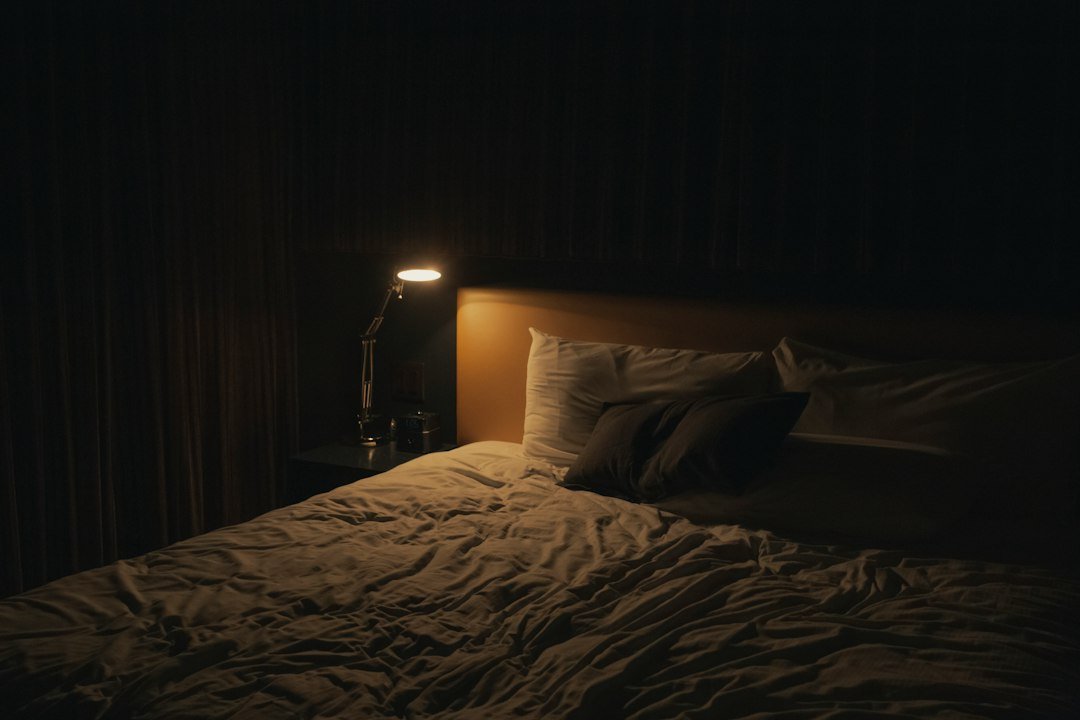
Your bedroom has to do the job the night normally does. The Brigham team recommends keeping it cool, dark and quiet, using an eye mask or blackout shades, and wearing earplugs or running white noise. It also helps to tell family or roommates when you sleep so they can avoid disturbing you.
- Darkness: start with our blackout curtain guide, then fix gaps with these light-leak fixes. Not sure which to buy? See blackout curtains vs sleep masks.
- Noise: compare brown noise and white noise, try our free sleep sound mixer, or read our guide to sleeping in a noisy city.
- Comfort: some people like the calming pressure of a weighted blanket. The research is limited (see our weighted blanket guide), and daytime sleep can run warm, so choose a breathable cover, as in our guide for hot sleepers.
You can score your own room with our sleep environment checker.
Step 4: Use caffeine and light on purpose
Caffeine is useful at work and harmful at bedtime, so timing matters. The Brigham team suggests having caffeine at the start of your shift and avoiding it for 3 to 4 hours before you want to sleep. They also note that small amounts every 1 to 2 hours can keep you more alert than one or two large doses, and that a short bout of exercise or a 15 to 20 minute nap on your break can help. Some people try a coffee nap: drink a coffee, then nap right away so the caffeine kicks in as you wake. Our guide to caffeine and sleep explains how long it stays in your system.
Light works the same way. Sunlight is a major cue that tells your body clock when to feel awake and when to feel tired (AARP), which is exactly why bright mornings on the drive home can undermine your sleep. Our guide on morning light and your body clock explains the basics.
A safety note: shift workers face a high risk of drowsy driving, especially on the commute home after a night shift. The Brigham team suggests considering a short nap in your car before you leave, and pulling over to nap if you start to feel drowsy at the wheel.
When to see a doctor
Feeling off for the first few weeks of a new schedule is common. But Sleep Foundation says to talk to a doctor if sleep problems or daytime sleepiness persist for several weeks, interfere with daily life, or make it hard to stay awake while driving or operating machinery. A shift work disorder diagnosis generally requires recurring symptoms for at least three months, and the Brigham team also advises seeing a sleep specialist if symptoms last that long. A doctor can check whether insomnia, sleep apnea or another sleep disorder is involved.
Melatonin comes up a lot with night workers. The Brigham team says it may help daytime sleep, but taken at the wrong time it can make sleep worse, so ask a sleep specialist about timing and dose.
Night shift sleep FAQ
How much should night shift workers sleep?
Most adults do best with at least seven hours in a 24-hour period, whether that comes in one block or is split. Shift workers often get less, so protecting your sleep window matters more than perfecting it.
Should I sleep right after my night shift?
Either approach can work. Some people sleep soon after getting home. Brigham specialists suggest two alternatives: delaying sleep so you wake near your next shift, or splitting your sleep into two blocks. Try each and see which gives you better rest.
Is it okay to nap before a night shift?
Yes. In a split-sleep pattern, a longer nap that ends just before your shift is part of the plan. On the job, a 15 to 20 minute break nap can also help you stay alert.
What time should I stop caffeine on a night shift?
Avoid caffeine for about 3 to 4 hours before you plan to sleep, and use it earlier in the shift instead.
How do I know if it’s shift work disorder?
Look for ongoing trouble sleeping when you try to rest, along with heavy sleepiness while you’re awake or at work. Symptoms need to last at least three months for a diagnosis, so see a doctor or sleep specialist if you suspect it.
The bottom line
You can’t make night work feel like day work, but a consistent sleep window, a very dark and quiet bedroom, a simple wind-down and smart caffeine timing will get you most of the way. For the full routine, including what to do on days off, read our complete sleep routine guide.
Sources
- Shift Work Disorder Symptoms, Sleep Foundation
- Sleep Tips for Shift Workers in the Time of Pandemic, Brigham and Women’s Hospital sleep and circadian team, Southwest Journal of Pulmonary, Critical Care and Sleep
- 7 Tips for Surviving the Fall Daylight Saving Time Change, AARP
This article is general information, not medical advice. If you have ongoing sleep problems, talk to your doctor.